
01 Overview & Architecture Evolution (OBC & DC/DC)
Engineering the Heart of 800V EV Power Density
As EV power platforms rapidly transition from 400V to 800V, and switching frequencies climb to 100kHz-500kHz+ driven by SiC/GaN WBG devices, traditional magnetic materials have reached their physical limits. Next-generation Integrated OBC + DC/DC architectures and Bidirectional CLLLC converters demand a completely new paradigm in magnetic material science.
MagComponent's iron-based nanocrystalline technology delivers a Bs of 1.2T-nearly triple that of conventional Mn-Zn Ferrite-enabling automotive engineers to aggressively reduce magnetic volume, eliminate thermal bottlenecks, and unlock 99%+ power conversion efficiency.
Key Advantage: Our nanocrystalline material maintains stable permeability across a wide temperature window (-40C to +150C). The high saturation of 1.2T guarantees that your CLLLC transformers and high-current chokes will not clip or experience sudden saturation during dynamic EV acceleration or DC fast-charging spikes.
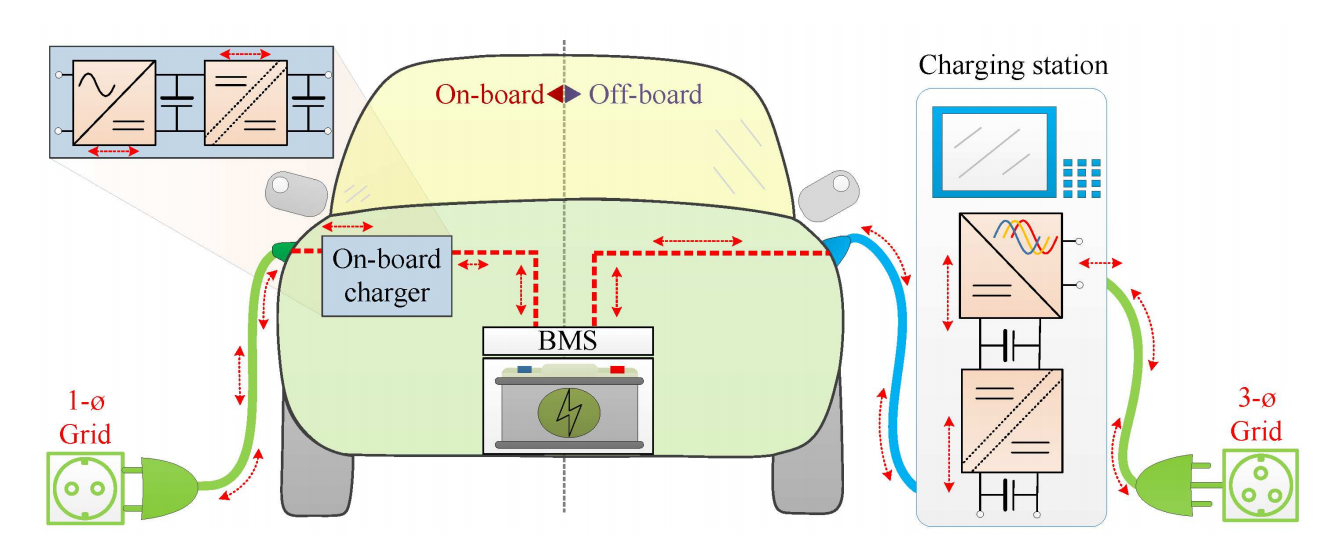
Fig 1: System Topology of High-Voltage Electric Vehicle On-Board Charger (OBC)
Traditional Si Platform (Legacy)
- 20-50 kHz Switching Frequency
- Bulky Mn-Zn Ferrite Transformers
- Discrete OBC and DC/DC Blocks
- Limited efficiency under high voltage
Next-Gen SiC-Based EV Platform (MagComponent Solution)
- 100-500kHz+ High-Frequency Operation
- Ultra-Compact Nanocrystalline Cores
- Integrated OBC + DC/DC Magnetics
- High Power Density
02 800V EV Industry Challenges
Why High-Frequency Magnetics Become the Next EV Bottleneck
Operating under continuous high-voltage and dynamic load conditions creates fierce performance penalties for soft magnetic components:
Exponential Core Loss Density
Traditional ferrites experience severe core loss escalation at 100kHz+ under 800V stress, risking thermal runaway.
Tighter Coupling Requirements
Resonant topologies like CLLLC and DAB demand precise, repeatable control of leakage inductance.
Severe SiC-Induced EMI
Fast dv/dt transients from SiC MOSFETs generate aggressive high-frequency common-mode noise, choking conventional filters.
Extreme Thermal Hotspots
Planar geometries and compact spatial footprints concentrate heat pathways, demanding materials with high operating limits.
03 Material Science: Why Nanocrystalline?
Based on MagComponent's Technical Characterization
To achieve the stringent automotive standards required for high power density and lifetime reliability, our 1K107 Nanocrystalline series introduces an undeniable competitive edge over conventional materials:
| Physical Parameter | Mn-Zn Ferrite | Silicon Steel (CRGO) | MagComponent Nanocrystalline | Automotive Engineering Advantage |
|---|---|---|---|---|
| Sat. Induction Bs (T) | 0.35 - 0.50 | 1.90 - 2.03 | ≈ 1.2 T typical | 3x Volume Reduction vs. Ferrite |
| Initial Permeability (μi) | 2,000 - 15,000 | 1,000 - 3,000 | typically > 80,000 | Broadband EMI Filtering |
| Core Loss P100k/0.1T | Medium | Intolerable | Ultra-Low (1/5 of Ferrite) | Enables 800V High-Freq Efficiency |
| Curie Temperature (Tc) | < 230C | 730C | 570 C | Zero Thermal Degradation at 150C |
| Magnetostriction (λs) | 1 - 5 x 10⁻⁶ | 7 - 12 x 10-6 | ≈ 2–3 × 10⁻⁶ | Low audible noise |
MagComponent nanocrystalline column: finished-core Bs ≈ 1.2 T typical (1K107 ribbon Bs ≈ 1.25 T). Initial permeability is grade- and anneal-dependent; the default high-μ claim is typically > 80,000. Saturation magnetostriction λs ≈ 2–3 × 10⁻⁶ is the DG Focus / MagComponent rectangular C-core catalog value.
Conclusion: Our nanocrystalline material maintains a stable permeability across a wide temperature window (-40C to +150C). The high saturation of 1.2T guarantees that your CLLLC transformers and high-current chokes will not clip or experience sudden saturation during dynamic EV acceleration or DC fast-charging spikes.
04 Core Solutions for EV Topologies
We translate material advantages into application-specific components. MagComponent provides three core architectures engineered for high-frequency EV platforms:
A. Planar Transformers with Hybrid Nanocrystalline/Ferrite Inserts
Optimized for Integrated OBC + DC/DC and Bidirectional CLLLC converters. Low-profile form factor maximizing surface-to-volume ratio for direct cold-plate mounting. Precision-engineered winding layouts yielding minimized, predictable leakage inductance.
B. High-Current Nanocrystalline Components & Common Mode Chokes (CMC)
Designed for advanced OBC EMI Filtering and DC-link noise suppression. Initial permeability is grade- and anneal-dependent. The default high-μ claim, matching 1K107, is typically > 80,000 (annealing on that ribbon page can set μ from about 1,500 to 300,000). That permeability is what cuts turns on fast SiC switching spikes. Drastically reduces copper turns, driving down DCR and copper losses under 150A+ dynamic current loads.
C. Integrated Magnetics Modules
Combining the LLC resonant inductor and main transformer into a single physical core structure. Drastically lowers Component Bill of Materials (BOM) and eliminates interconnecting copper paths. Saves up to 40% system footprint in compact passenger EV engine bays.
05 Engineered EV Application Grid
Our components are integrated directly into the following essential automotive subsystems:

Fig 2: Circuit Topology for Integrated OBC + Bidirectional DC-DC Converters
06 Technical Insight: Solving the High-Frequency Bottlenecks
The Engineer's Trust Zone - Written by Engineers, For Engineers.
6.1 Precision Leakage Inductance Control in CLLLC Platforms
In bidirectional CLLLC converters, the leakage inductance of the transformer is frequently utilized as part of the resonant tank. Traditional manufacturing suffers from loose tolerances. MagComponent utilizes custom gapping techniques and multi-layer planar PCB interleaving to lock down leakage inductance tolerances to within +/-2%, securing stable Zero Voltage Switching (ZVS) and Zero Current Switching (ZCS) across wide input-voltage margins.
6.2 Mitigating Proximity Effects and Thermal Hotspots
At 200kHz+, skin effect and proximity effect exponentially increase AC copper resistance (Rac). When packed into tightly sealed planar envelopes, heat dissipation becomes critical. By employing thin-ribbon (14-18um) nanocrystalline structures with optimized core windows, we lower the specific loss density (Pcv), ensuring the inner core temperature remains well below its 570C Curie limit, avoiding the thermal dropouts common to Ferrite.
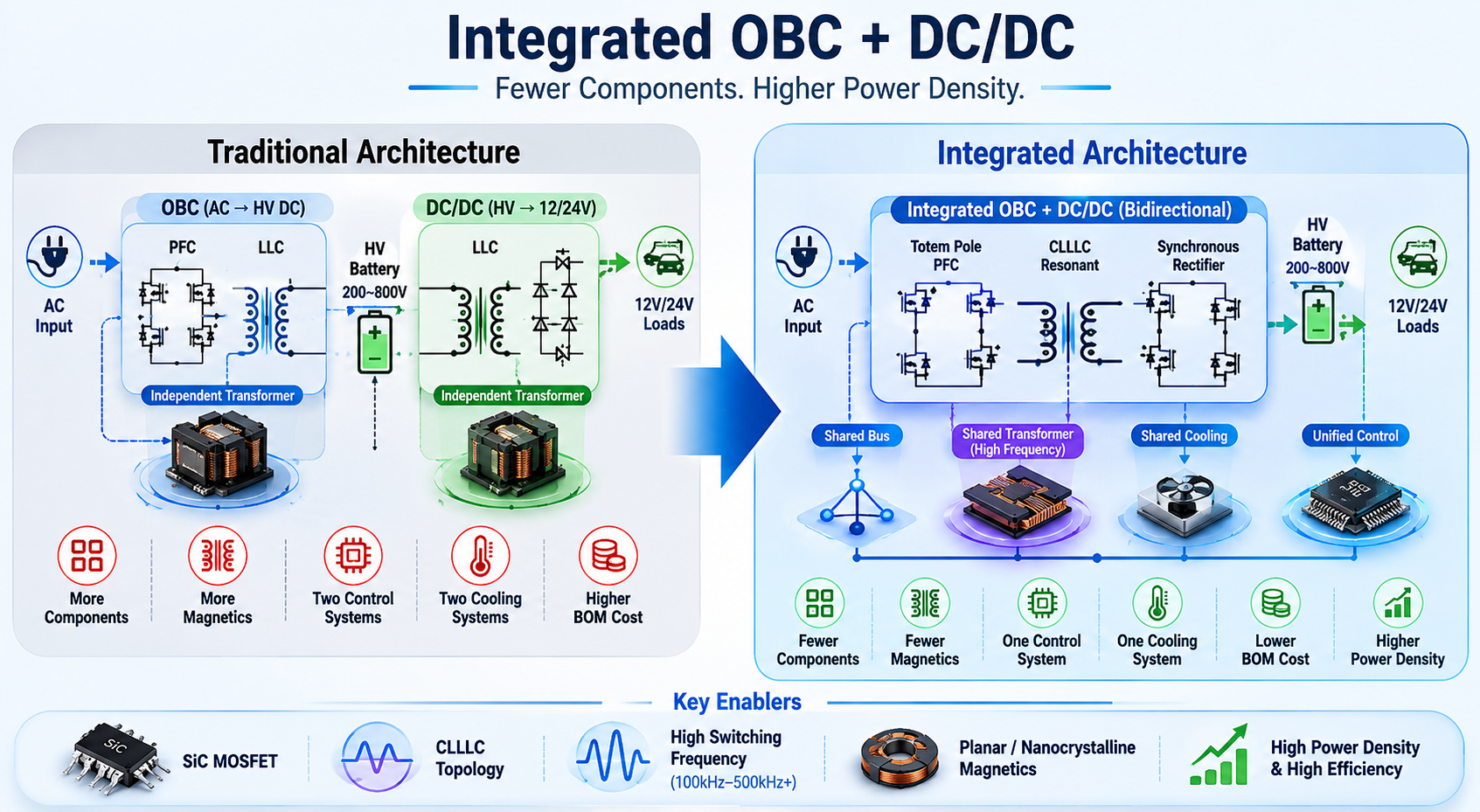
Fig 3: Volumetric Reduction and Magnetic Integration: Traditional Si Layout vs. SiC Integrated Combo Unit
6.3 Taming SiC High dv/dt Common-Mode Noise
SiC MOSFETs feature ultra-fast switching rise times, generating high dv/dt which excites parasitic capacitances throughout the EV chassis. Traditional Mn-Zn ferrites lack the broad impedance bandwidth to damp these high-frequency resonances. MagComponent's nanocrystalline chokes feature a highly tuned impedance-vs-frequency curve, delivering high attenuation from 150kHz up to 30MHz in a fraction of the physical size.
Optimize Your EV Power Electronics
Partner with MagComponent for nanocrystalline cores used in EV onboard chargers and 800 V platforms