
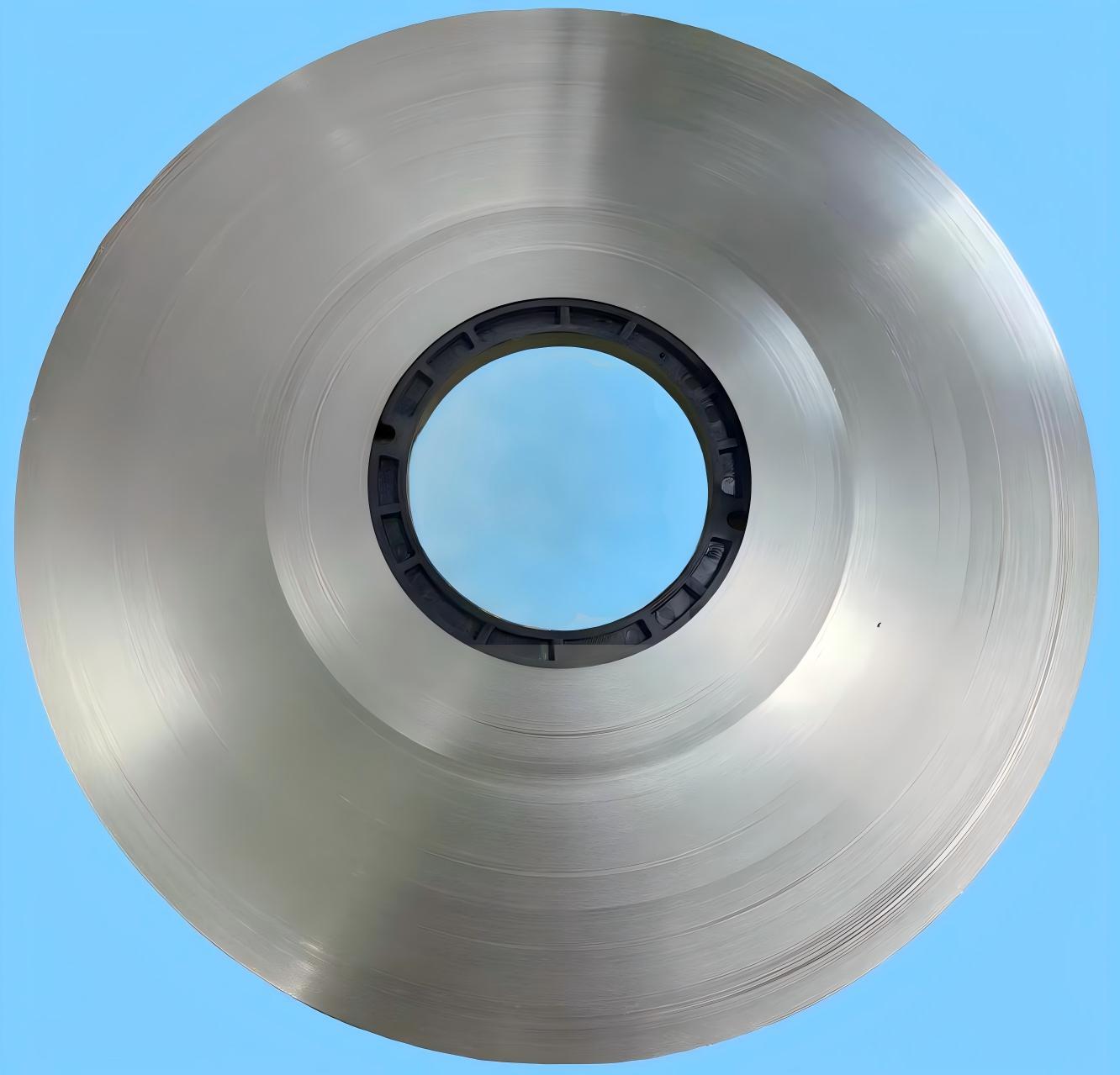
Fe-based nanocrystalline ribbon with a typical grain size of about 10 nm. Saturation flux density Bs ≈ 1.25 T, initial permeability typically > 80,000, and saturation magnetostriction λs ≈ 2–3 × 10⁻⁶ for very low audible noise.
Fe-based nanocrystalline ribbon catalog figures for the 1K107 series (FeCuNbSiB). Heat-treatment grades LM, NM, and TM set the remanence ratio.
| Composition | FeCuNbSiB, nanocrystalline after heat treatment |
| Saturation flux density (Bs) | ≈ 1.25 T for the 1K107 series. Low-μ grades are listed at 1.10–1.30 T. |
| Initial permeability (μi) | Typically > 80,000. Annealing can set μ from about 1,500 to 300,000. |
| Coercive force (Hc) | < 1.5 A/m (≤ 1.5 A/m on the LM / NM / TM table) |
| Saturation magnetostriction (λs) | λs ≈ 2–3 × 10⁻⁶, the DG Focus / MagComponent nanocrystalline rectangular C-core catalog value. Very low magnetostrictive noise. |
| Core loss | < 50 W/kg at 100 kHz, 300 mT. Thin-ribbon grades: P20k/0.5T < 6 W/kg. |
| Curie temperature | ~570°C (1K107 series). Low-μ grades ~560°C. |
| Crystallization temperature | ~530°C (1K107 series). Low-μ grades ~510°C. |
| Density | 7.20 g/cm³ |
| Resistivity | 120 μΩ·cm |
| Ribbon thickness | Series form 14–26 μm. Typical available range 10–28 μm. Thinner ribbon lowers high-frequency loss. |
| Ribbon width | Typically 2–122 mm. Custom widths on request. |
| Stacking factor | Typically 75–80%, depending on thickness and winding. |
| Permeability vs. temperature | μ variation typically < ±10% from −40°C to 140°C. From 25°C to 150°C, initial permeability decrease is typically < 20%. μ stays highly stable at 100°C over time. |
LM is a longitudinal-field anneal, NM is no field, and TM is a transverse-field anneal. 1K107NM and 1K107TM typically show lower core loss than 1K107LM at 20 kHz.
| Material | Composition | μi | Br/Bs | Hc (A/m) | Bs (T) | ρ (μΩ·cm) |
|---|---|---|---|---|---|---|
| 1K107 (LM) | FeCuNbSiB | 30k–60k | 85–95% | ≤ 1.5 | 1.25 | 120 |
| 1K107 (NM) | FeCuNbSiB | 50k–100k | 45–65% | ≤ 1.5 | 1.25 | 120 |
| 1K107 (TM) | FeCuNbSiB | 30k–150k | 5–20% | ≤ 1.5 | 1.25 | 120 |
| Fe-based amorphous | FeSiB | ~5,000 | ~85% | ≤ 2.5 | 1.56 | 120 |
| Co-based amorphous | >50% Co | ~300,000 | >90% | ≤ 1.5 | 0.5–0.9 | 140 |
| Iron | 99.8 Fe | 150 | — | 80 | 2.14 | 10 |
| NO 3% Si-steel | 3Si–Fe | 270 | — | 60 | 2.01 | 47 |
| GO 3% Si-steel | 3Si–Fe | 1,400 | — | 7 | 2.01 | 50 |
| 1J50 Permalloy | 48Ni–Fe | 11,000 | — | 2 | 1.55 | 48 |
| 1J84 Permalloy | 4Mo79Ni | 40,000 | — | 1 | 0.8 | 58 |
| 1J85 Permalloy | 5Mo80Ni | 80,000 | — | 0.4 | 0.78 | 65 |
Saturated field for the tunable ribbon is about Hm ≈ 30–350 A/m. Values follow the ribbon catalog comparison table.
1K107 and FN grades for high-frequency power transformers, common-mode chokes, current transformers, and wireless power transfer. Other dimensions can be customized.
| Grade | Thickness (μm) | Bs (T) | Hc (A/m) | Typical use |
|---|---|---|---|---|
| 1K107B | 14–26 (bands) | 1.24 | ≤ 1.5 | HFPT and CMC — high μ, low loss bands by thickness |
| 1K107BW | 22–28 | 1.24 | ≤ 1.5 | CMC / CT — high μ at 10 kHz and 50 Hz |
| 1K107E | 18–22 | 1.24 | ≤ 1.5 | CT — μ (50 Hz) typically 80k–500k |
| 1K107G | 22–28 | 1.24 | ≤ 1.5 | CT — μ (50 Hz) typically 140k–500k |
| 1K107W | 14–26 | 1.24 | ≤ 1.5 | CT — μ (50 Hz) typically 150k–500k |
| 1K107H | 18–26 | 1.40 | ≤ 2.5 | Higher Bs; CT / WPT oriented |
| FN-200/100/080/035 | per grade | — / 1.25 | ≤ 2.0–3.0 | WPT and CMC, controlled-μ / loss grades |
| 1K107B1 | 16–22 | > 1.1 | ≤ 1.5 | CMC — stacking factor > 85% options |
HFPT = high-frequency power transformer. CMC = common-mode choke. CT = current transformer. WPT = wireless power transfer.
Transforming high-frequency power electronics across multiple industries
Onboard chargers (OBC) and DC-DC converters benefiting from high-frequency efficiency and compact design.
High-frequency power conversion with superior thermal stability and efficiency in photovoltaic systems.
Solid State Transformers requiring high power density and advanced thermal management capabilities.
Medical imaging and equipment magnetics, where low loss and low magnetostrictive noise matter.
Enabling the global transition to green energy through advanced material science
High saturation and high permeability support high-frequency, miniaturized designs in EV, inverter, and grid magnetics.
Compact design minimizes raw material requirements while maintaining superior performance.
Supports global decarbonization goals through efficient power conversion and reduced energy waste.
Experience the superior performance of 1K107 nanocrystalline ribbon and transform your high-frequency applications.