Table of Contents
- Introduction
- 1. What is Magnetic Permeability?
- 2. The Permeability Paradox
- 3. Permeability & Thermal Management
- 4. Matching μ to Switching Frequency
- 5. Case Study: 96% Weight Reduction
- Conclusion
- Optimize Your EMI Filter
Magnetic Permeability in EMI Suppression: Nanocrystalline vs. Ferrite
The Hidden Engine of EMI Filters: Magnetic Permeability
When designing an Electromagnetic Interference (EMI) filter for high-power density applications like EV chargers, solar inverters, or Solid State Transformers (SST), the goal is simple: Maximum attenuation in minimum space.
The key to achieving this is Magnetic Permeability (μ). However, a common pitfall for many designers is focusing solely on the initial permeability value found on a static datasheet. In high-performance power electronics, the real engineering challenge lies in the dynamic shifts of frequency, temperature, and current.
1. What is Magnetic Permeability (μ) in the Context of EMI?
In EMI suppression—specifically for Common Mode Chokes (CMC)—permeability is the measure of a material's ability to support the formation of a magnetic field.
The relationship is defined by the fundamental inductance formula:
L = (μ₀ × μᵣ × N² × Aₑ) / lₑ
Why this matters for your BOM:
As shown, Inductance (L) is directly proportional to Permeability (μ). By utilizing materials with higher μ, you achieve the required impedance with significantly fewer wire turns (N). This leads to a "Domino Effect" of benefits:
- Reduced Copper Loss (DCR): Fewer turns mean shorter wire lengths.
- Lower Parasitic Capacitance: Improved high-frequency bypass and performance.
- Component Shrinkage: Drastic reduction in total component volume.
2. The Permeability Paradox: Why High μ Isn't Always Better
While high permeability is desirable for low-frequency noise (150 kHz), it often comes with a trade-off: Saturation.
Traditional MnZn Ferrites offer high initial permeability (5,000 to 15,000), but they saturate quickly under DC bias. Once the material reaches its Saturation Induction (Bₛ), permeability drops to nearly zero. Your EMI filter effectively becomes an expensive piece of wire, failing to meet EMC standards.
The Material Battle: Nanocrystalline vs. Ferrite
| Feature | MnZn Ferrite | Nanocrystalline (MagComponent) | Impact on Design |
|---|---|---|---|
| Saturation (Bₛ) | ~0.45 T | 1.25 T | 3x higher current handling |
| Permeability (μ) | 10k - 15k | 30k - 100k+ | Up to 70% volume reduction |
| Temp. Stability | High Drift(below 100°C) | Ultra-Stable (-40 to +140°C) | Consistent EMI compliance |
| Frequency Range | 100kHz - 1MHz | 10kHz - 30MHz+ | Broader noise suppression |
3. How Permeability Curves Affect Thermal Management
A major pain point in 10kV+ or high-power units is the "Hot Spot" within the filter. This is often driven by high core losses.
By analyzing the Static Initial Magnetization Curve (B-H Loop), we see that MagComponent's Nanocrystalline materials feature a much "slimmer" loop compared to Ferrites. A thinner loop translates to lower hysteresis loss.
Furthermore, high-permeability cores allow for a reduction in winding layers. Fewer layers enhance airflow and reduce heat buildup, solving the thermal bottleneck in compact designs.
4. Strategic Selection: Matching μ to Your Switching Frequency
With the rise of Silicon Carbide (SiC) and Gallium Nitride (GaN), switching frequencies are pushing past 50 kHz into the MHz range.
- Low Frequency (150 kHz - 1 MHz): You need high permeability to provide enough impedance to block fundamental switching noise.
- High Frequency (10 MHz - 30 MHz): You need a material that maintains stability without a "cliff-dive" drop-off in permeability.
MagComponent's Nanocrystalline cores (such as the Antainano® 1K107 series) are engineered for this. Unlike Ferrites, which lose effectiveness as they heat up, our cores maintain a flat permeability curve across a wide temperature and frequency range.
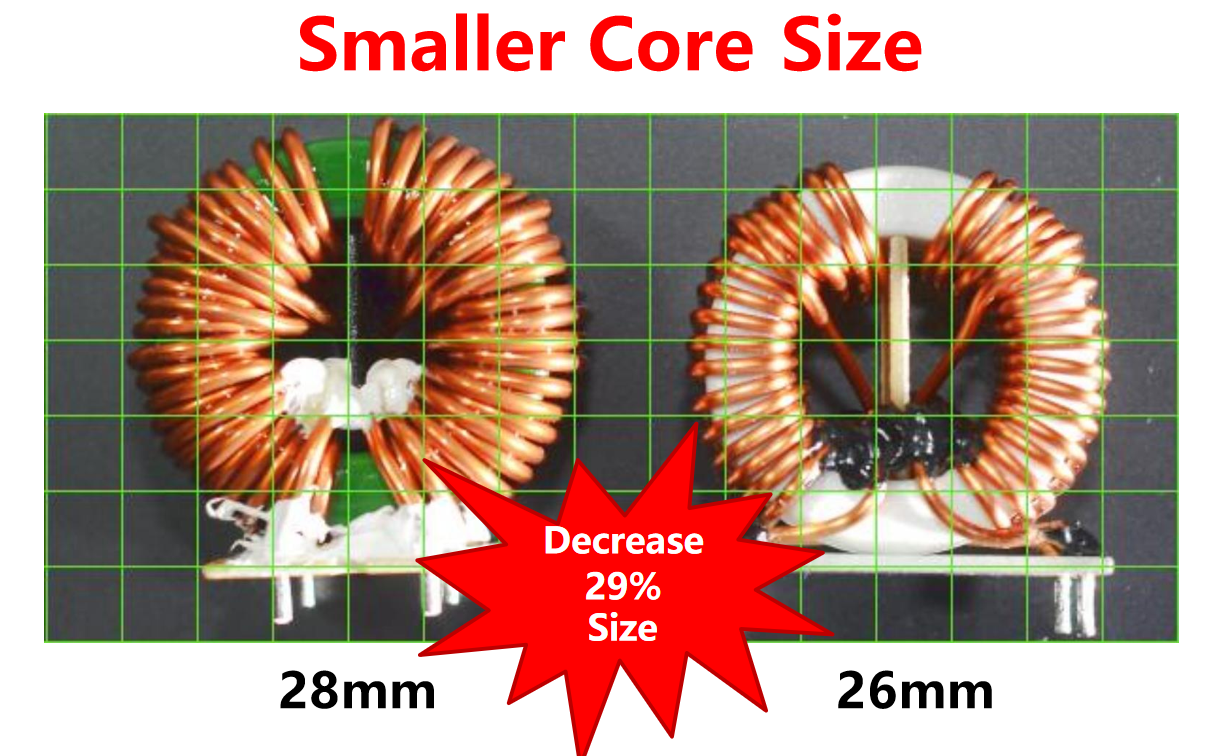
5. Case Study: 29% Size Reduction in EMI Filter Design
By upgrading from traditional Ferrite cores to MagComponent's high-permeability Nanocrystalline cores, a major power electronics manufacturer achieved significant size reduction in their EMI filter design:
Conclusion: Don't Let Your Core Be the Bottleneck
For CEOs and Founders, the choice of magnetic material is a choice of product competitiveness. For Engineers, it is the difference between a passed EMC test and a costly redesign.
Your EMI suppression strategy is only as strong as your core's permeability under real-world conditions.
Ready to Optimize Your EMI Filter?
At MagComponent (DG Focus Technology), we specialize in high-performance Nanocrystalline solutions that redefine power density.
Need B-H loop data or a Ferrite vs. Nanocrystalline comparison for your specific project?