
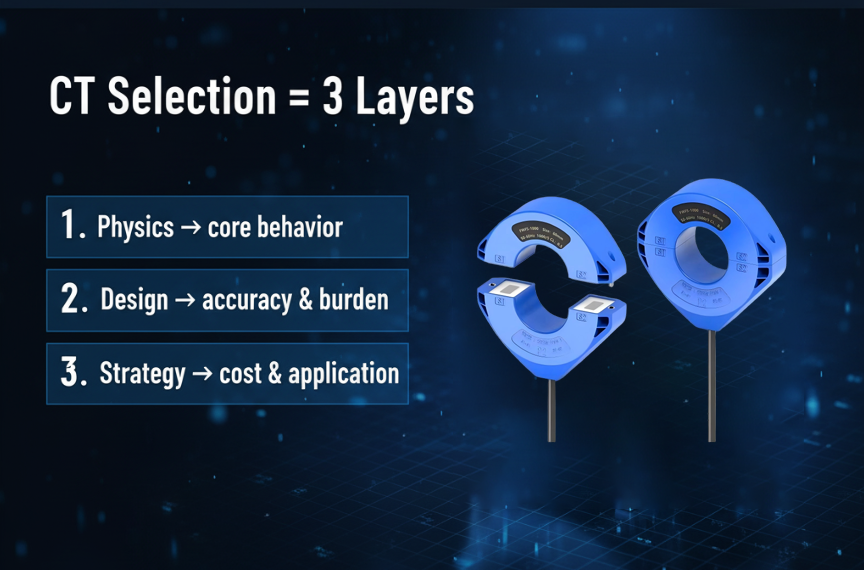
The current transformer industry is entering an unprecedented technological explosion period.
The current transformer industry is entering an unprecedented period of technological innovation. As power systems evolve toward greater intelligence, efficiency, and higher frequency operation, current transformers are undergoing significant transformation to meet the demands of modern power electronics and renewable energy applications.
Digital Current Transformers & Merging Units
With the growing adoption of digital sampling protocols like IEC 61850-9-2, transformers are increasingly performing analog-to-digital conversion directly at the point of measurement. Digital transformers eliminate secondary load interference caused by cable transmission and completely resolve insulation challenges at high voltage levels through optical fiber communication.
Key Advantages of Digital CTs
- Elimination of secondary load effects
- Enhanced insulation performance through fiber optics
- Direct compatibility with digital protection systems
- Improved accuracy through advanced signal processing
Optical Current Transformers (OCT): The Ultimate Solution for High Voltage
Optical transformers utilize the Faraday rotation effect, calculating current by measuring the deflection angle of a laser's polarization plane within a magnetic field. They offer complete electrical insulation, zero saturation, wide bandwidth (extending up to tens of kilohertz), and compact form factors.
Market outlook: Projections indicate the OCT market will maintain a compound annual growth rate exceeding 8% through 2033, with particular demand in smart grid applications and flexible DC transmission projects.
High-Frequency Current Transformers (HFCT) & Partial Discharge Monitoring
In high-frequency converters utilizing silicon carbide (SiC) and gallium nitride (GaN) semiconductors, traditional transformers often fail due to insufficient bandwidth. High-frequency current transformers (HFCT) have become essential, with bandwidth capabilities spanning from 60kHz to 70MHz. Additionally, HFCT serves as a core sensor for cable partial discharge (PD) monitoring, capable of capturing extremely weak high-frequency discharge signals to support predictive maintenance programs.
Applications of HFCT
- SiC/GaN-based high-frequency converters
- Electric vehicle charging systems
- Renewable energy inverters
- Cable partial discharge monitoring
- Power quality analysis
Industry Overview & Strategic Recommendations
As someone with decades of experience in the magnetic components industry, I recognize that the current transformer sector has moved beyond the simplistic era of competing solely on price and turns ratio.
Strategic Recommendations
Target Precision and Advanced Materials
In high-end metering and industrial monitoring applications, Class 0.2S transformers and nanocrystalline core products represent significant market opportunities. By offering solutions with superior accuracy and minimal temperature drift, companies can differentiate themselves from commodity silicon steel products and avoid price competition.
Stay Ahead of Compliance Requirements
UL 2808 certification for North America and upcoming Eco-Design requirements in Europe represent important compliance milestones for the next five years. Companies that obtain these certifications early will gain market access advantages.
Embrace Digital Transformation
Focus on developing "smart CTs" with communication capabilities such as RS485, wireless LoRa, or narrowband IoT. In the era of the Industrial Internet of Things (IIoT), transformers are evolving from standalone components to integrated nodes within broader energy management solutions.
Prioritize Supply Chain Transparency
Given evolving export policies, establishing transparent and compliant supply chains is not only a regulatory requirement but also a strategic advantage that enhances brand reputation in global markets.
Conclusion
The future of current transformers will be shaped by the convergence of digitalization, miniaturization, and high-frequency capabilities. In today's competitive global market, sustained success requires deep technical expertise, proactive engagement with evolving standards, and strategic investment in advanced materials research.
As we stand at the threshold of this technological revolution, the current transformer industry is positioned for significant growth and innovation. By embracing these emerging trends and implementing thoughtful strategic approaches, manufacturers can establish themselves as leaders in this dynamic and evolving field.
Stay Ahead of the CT Technology Curve
Partner with MagComponent to leverage our expertise in advanced current transformer technology and navigate the digital revolution in power monitoring.
Explore Our CT SolutionsRelated Articles
Current Transformer Core Mechanism & Strategic Position
Exploring the core mechanism and strategic importance in power systems.
Current Transformer Accuracy Classes & Performance Analysis
Detailed analysis of accuracy classes, performance characteristics, and magnetic materials.
Global Current Transformer Market & Trade Barriers
Analysis of international standards, trade barriers, and competitive landscape.