
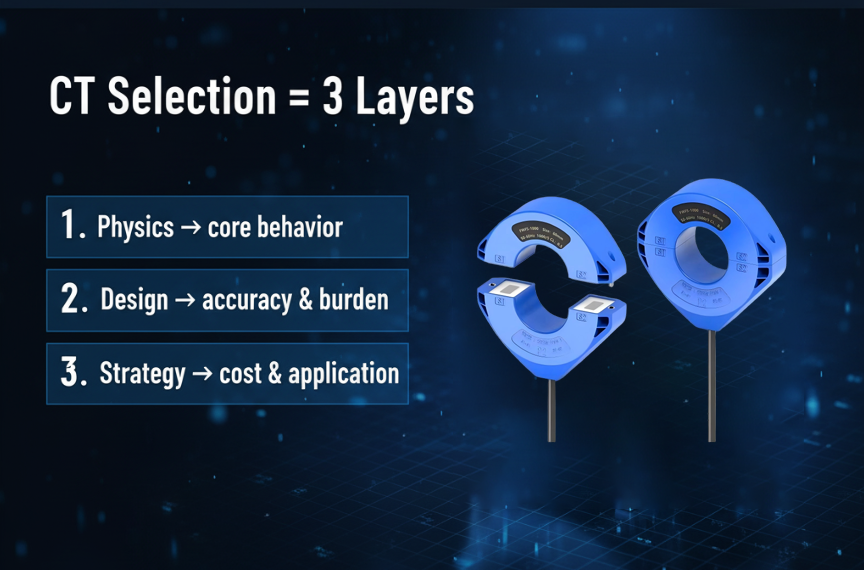
Current transformer technology forms the backbone of modern power system monitoring and protection.
In the complex architecture of the power industry, current transformers (CTs) are more than just practical applications of electromagnetic induction—they are fundamental pillars supporting modern power grids by enabling precise monitoring, reliable protection, and equitable commercial transactions. From a technical standpoint, CTs achieve critical electrical isolation between high-voltage systems and low-voltage measurement/control circuits through carefully calibrated proportional conversion between primary and secondary currents.
This isolation isn't merely a safety requirement; it forms the physical foundation for data-driven grid operations. For those of us with decades of experience in magnetic components, we've witnessed CTs evolve from simple iron-core devices to sophisticated precision instruments that integrate advanced materials science, digital sensing technology, and rigorous international standards.
The Physics of Current Transformers
Current transformers operate on Faraday's law of electromagnetic induction, with their core relationship expressed through the familiar formula that demonstrates the inverse relationship between primary current I₁, secondary current I₂, and their respective winding turns N₁, N₂:
I₁ × N₁ ≈ I₂ × N₂
In real-world applications, we inevitably encounter ratio error and phase displacement. These deviations arise from excitation current losses during the core magnetization process—an inherent challenge in transformer design.
As global smart grid initiatives advance, CTs are evolving from simple analog signal sources to sophisticated digital sensing terminals. This shift is particularly critical in industrial power distribution, high-voltage substations, and energy metering applications, where transformer accuracy directly impacts the fairness of substantial electricity billing settlements and the reliability of relay protection systems that must respond to faults within milliseconds.
Engineering Perspective
The evolution of CT technology mirrors broader changes in the power industry. As grids become more digital and decentralized, CTs function increasingly as the "nerve endings" of power systems—providing the real-time data needed for both operational decisions and system protection.
Global Application Scenarios
Current transformers have evolved beyond their traditional role as power system components—they now serve as essential elements in green energy systems, industrial automation, and digital infrastructure.
Electric Vehicle (EV) Charging
In EV charging stations, CTs perform dual functions: precise billing metering and real-time monitoring of both AC and pulsed DC leakage currents. For 350kW+ ultra-fast charging systems, minimizing CT losses is critical to meet thermal management and space constraints. Additionally, the shift toward 800V high-voltage platforms has created significant demand for high-frequency magnetic components in onboard chargers.
Industrial Automation
Installing split-core CTs on critical motor circuits enables the detection of subtle anomalies in current waveforms. For instance, current harmonic changes caused by bearing wear can be identified months before equipment failure—allowing maintenance teams to address issues proactively rather than reactively. This capability elevates CTs from simple measurement devices to essential tools for predictive maintenance programs.
Data Centers
Modern data centers focus on optimizing power usage effectiveness (PUE) down to the server rack level. This requires CTs that are compact, capable of monitoring multiple circuits, and equipped with digital communication interfaces like RS485 or Ethernet. Digital transformers that output IEC 61850 sampled values simplify secondary circuit design and reduce installation costs.
Ready to Optimize Your Current Transformer Solutions?
Partner with MagComponent for high-precision current transformer solutions tailored to your specific application needs.
Contact Our Technical TeamRelated Articles
Current Transformer Accuracy Classes & Performance Analysis
Detailed analysis of accuracy classes, performance characteristics, and magnetic materials.
Global Current Transformer Market & Trade Barriers
Analysis of international standards, trade barriers, and competitive landscape.
Current Transformer Future Trends & Digital Revolution
Exploring digitalization, high-frequency applications, and strategic recommendations.