
Are Your EMI Filters Ready for CISPR 32 Standards?
The CISPR 32 Challenge
To ensure your EMI filters are ready for CISPR 32 standards, you must prioritize high-frequency impedance and thermal stability. The transition from CISPR 22 to CISPR 32 has tightened the limits for multimedia equipment, making traditional MnZn ferrite cores insufficient due to their lower permeability and saturation levels.
The most effective solution is integrating Nanocrystalline cores, which offer 10x the permeability of ferrites, allowing your filters to achieve higher insertion loss in a 50% smaller volume while maintaining 99.5% efficiency.
What is CISPR 32 and Why Does It Matter?
CISPR 32 is the international standard for the Electromagnetic Compatibility (EMC) of Multimedia Equipment (MME). It replaced the older CISPR 22 (ITE) and CISPR 13 (Audio/Video) standards to harmonize testing requirements for modern, integrated devices.
For engineers, the challenge lies in the Class B conducted emission limits, which are particularly strict in the 150 kHz to 30 MHz range. If your EMI filter isn't optimized, your product won't hit the market.
The Bottleneck: Why Traditional Ferrites Fail CISPR 32 Tests
Most engineers default to Manganese-Zinc (MnZn) ferrite cores for common mode chokes. However, as switching frequencies increase in SiC and GaN designs, ferrites encounter three major hurdles:
- • Low Saturation (Bs): Ferrites saturate at ~0.4T, leading to filter performance degradation under high current loads.
- • Temperature Instability: Ferrite permeability drops significantly as temperatures rise towards 100°C.
- • Size Constraints: To meet CISPR 32 Class B, ferrite-based chokes often become too bulky for modern compact enclosures.
The Nanocrystalline Advantage: Engineered for Compliance
At MagComponent, we specialize in Nanocrystalline cores that turn EMI compliance from a headache into a competitive advantage. Based on technical data from leading materials research (such as AT&M and Yunlu), here is how Nanocrystalline outperforms:
1. Superior Permeability (μ) Across Frequencies
Nanocrystalline materials like Antainano® exhibit initial permeability ranging from 30,000 to over 150,000. In comparison, high-mu ferrites peak at 15,000.
Result: You get significantly higher impedance with fewer copper windings, reducing parasitic capacitance and improving high-frequency performance—essential for the 10MHz+ range in CISPR 32 testing.
2. High Saturation Induction (1.25T)
Nanocrystalline cores have a saturation induction (Bs) of 1.25T, triple that of ferrites.
Design Impact: This allows the core to handle higher DC bias currents without losing inductance, ensuring your EMI filter remains effective even at peak power.
3. Footprint Reduction (The 50% Rule)
According to industry case studies, replacing a ferrite core with a Nanocrystalline core in a 5kW inverter can reduce the total filter weight by over 40% and volume by 50%.
Reference: A standard transformer/choke weight can drop from 160kg to a mere 5.1kg when shifting to high-frequency nanocrystalline designs (Source: DC Research Center).
Case Study: Passing CISPR 32 Class B in EV OBC Designs
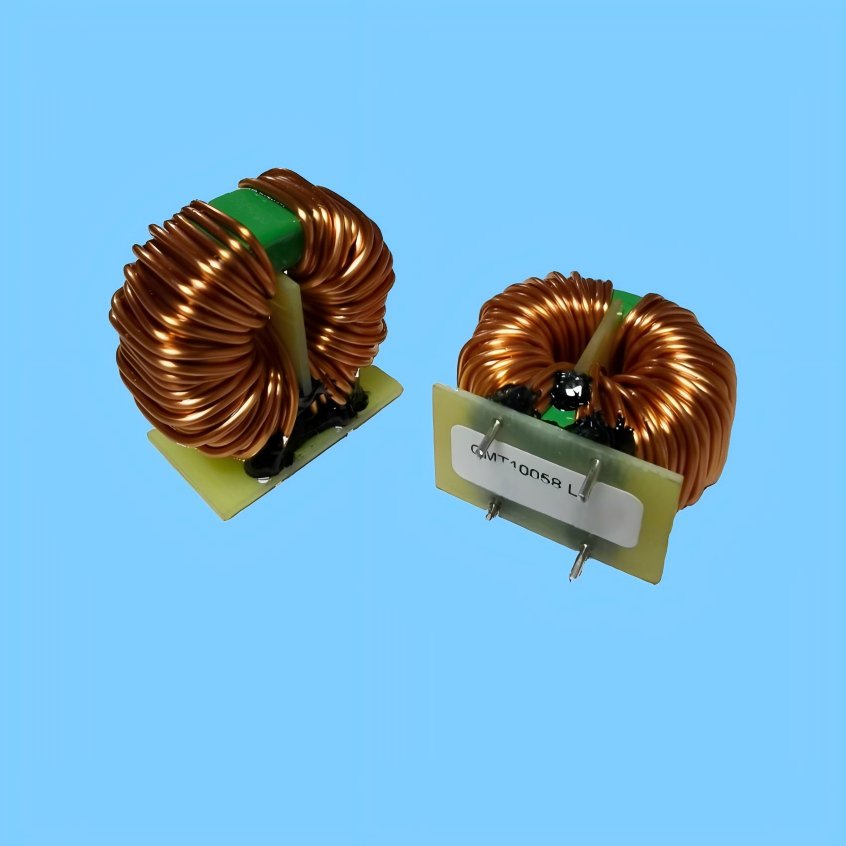
In Electric Vehicle On-Board Chargers (OBC), EMI filters must be ultra-compact. Using MagComponent's Nanocrystalline Common Mode Cores, one client achieved:
Checklist: Is Your Filter Ready?
Before your next lab visit, ask these four questions:
- • Does my choke saturate at maximum operating current? (If yes, switch to Bs = 1.25T Nanocrystalline).
- • Is my impedance high enough at 150kHz? (Nanocrystalline offers 10x the AL value).
- • Will the filter pass at 105°C? (Nanocrystalline has a Curie temperature >560°C, vs ferrite's ~200°C).
- • Is there enough space for cooling? (Nanocrystalline's efficiency reduces heat dissipation needs).
Conclusion: Don't Let Magnetics Be Your Bottleneck
As power densities rise, the "old way" of using silicon steel or ferrite for EMI filters is becoming a liability. To meet CISPR 32 and stay ahead of the competition, Nanocrystalline is no longer an alternative—it's a requirement.
Ready to shrink your next design and pass EMC on the first try?
Ready to Optimize Your EMI Filter?
Contact MagComponent today at julia@magcomponent.com to request our "Nanocrystalline vs. Ferrite" Loss Comparison Datasheet.
Request Technical Quote